
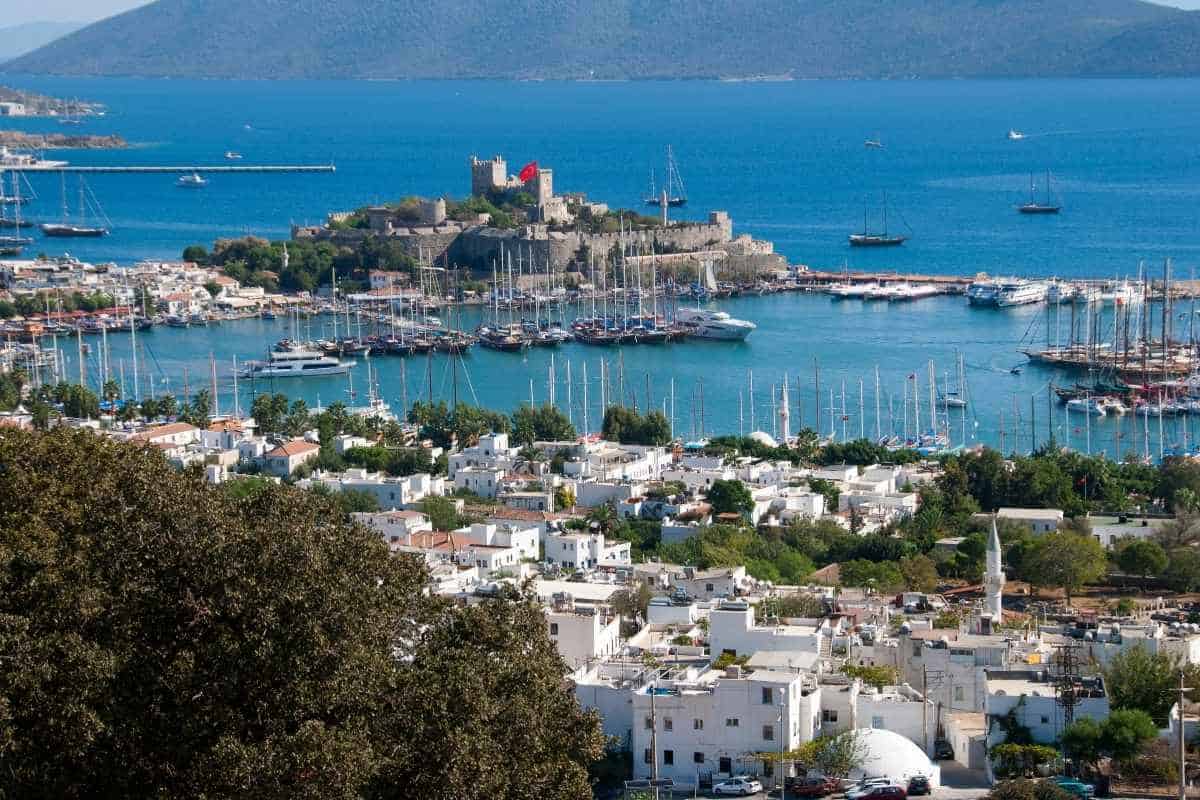
Sunlight flashes across the Aegean as the stone towers of Bodrum Castle rise above Bodrum’s harbor, guarding the marina with the confidence of a fortress that has watched empires come and go. From its ramparts, whitewashed houses spill down the hillside, gulets rock gently in turquoise water, and the air carries the scent of sea salt, pine, and warm stone.
Historical and Cultural Context
Bodrum Castle, also known as the Castle of St. Peter, was built by the Knights Hospitaller beginning in 1402, during a turbulent period when Crusader powers, Anatolian beyliks, and the rising Ottoman Empire were competing for control of the eastern Mediterranean. The knights used stones from the nearby Mausoleum at Halicarnassus, one of the Seven Wonders of the Ancient World, giving the castle a direct link to Bodrum’s ancient past.
The fortress was designed as a powerful coastal defense, with separate towers maintained by different knightly “languages” or national groups, including the English, French, German, Italian, and Spanish. In 1522, after the Ottoman conquest of Rhodes, the castle passed peacefully into Ottoman hands. Centuries later, it served various roles, including military barracks and a prison, before becoming one of Turkey’s most fascinating cultural landmarks.
What to See and Experience
Inside Bodrum Castle, stone corridors open onto courtyards shaded by palms, bougainvillea, and cypress trees. Climb the towers for sweeping views over Bodrum, Turkey, where the marina glitters below and the coastline curves into the blue distance.
One of the highlights is the Bodrum Museum of Underwater Archaeology, housed within the castle complex. Exhibits display ancient shipwreck finds, amphorae, glassware, coins, anchors, and cargo recovered from the Aegean seabed. The famous Uluburun shipwreck collection, dating to the Late Bronze Age around the 14th century BC, reveals a world of maritime trade stretching from Egypt and Cyprus to Anatolia and the Levant.
As you wander, notice the carved coats of arms, heavy stone gateways, and quiet inner gardens. The castle feels both martial and graceful—built for defense, yet softened by sea breezes and Mediterranean light.
Practical Visitor Tips
The best time to visit Bodrum Castle is in spring or fall, when temperatures are pleasant and the crowds are lighter. Summer offers brilliant skies, but arrive early in the morning or late afternoon to avoid the strongest heat.
Plan to spend 1.5 to 2.5 hours exploring the fortress and museum exhibits. Wear comfortable shoes, as there are uneven stones, stairways, and sloped paths. Bring water, a hat, and a camera—the viewpoints are among the finest in Bodrum.
Explore More of Turkey
If Bodrum inspires you to see more of the country, browse our curated Turkey tours or consider the 10-Day Best of Turkey: Istanbul, Pamukkale, Ephesus, Cappadocia for a wider journey through ancient cities, surreal landscapes, and cultural treasures.
Bodrum Castle is more than a fortress on the sea—it is Bodrum’s stone memory, standing proudly between the ancient world and the bright rhythm of modern Turkey.