
 5 Days
Travel Safety Guide
Is It Safe to Travel to Istanbul, Turkey Right Now?
A clear, honest answer for travelers from the US and Canada — reviewed against official advisories and current local service information for Istanbul. We do not overstate safety, and we update this page as conditions change.
TÜRSAB Licensed #6073
Operating since 2008
Istanbul office + US support
Written 5-day cancellation policy
Support contact stated in each confirmation
Quick answer
Istanbul is open and receiving international visitors normally, and it sits well outside the only part of Türkiye that carries a “do not travel” warning. It also calls for more situational awareness than a trip to Rome.The U.S. State Department places Türkiye at Level 2 — Exercise Increased Caution, citing terrorism, armed conflict and arbitrary detentions. Canada advises a high degree of caution. The only “do not travel” zone is a 10 km strip along the Syrian and Iraqi borders, roughly 1,000 km from Istanbul and not on any itinerary we operate.In practice: avoid demonstrations, stay alert in crowds and transport hubs, take the ordinary big-city precautions against pickpocketing and overcharging, and check your own government’s advisory and your flight shortly before you fly.
Official advisory snapshot
Level 2 — Exercise Increased Caution U.S. State Department: Level 2 — Exercise Increased Caution. Advisory issued 9 June 2026.
Areas identified in the stored advisory note: The U.S. State Department lists Türkiye at Level 2 — Exercise Increased Caution due to terrorism, armed conflict, and arbitrary detentions. Its only Level 4 “do not travel” zone is within 10 km (6 miles) of the Syrian and Iraqi borders.Canada advises a high degree of caution countrywide due to the threat of terrorist attacks and demonstrations. Canada goes one step further regionally: it advises against all travel within 10 km of the Iraqi and Syrian borders, and against non-essential travel to several southeastern provinces, among them Batman, Bingöl, Bitlis, Hakkari, Kilis, Siirt, Şırnak and Tunceli.Istanbul, Cappadocia, Pamukkale, Ephesus and Antalya lie outside both countries’ restricted zones, and no One Nation Travel itinerary enters them. Check official guidance for your own nationality and exact itinerary before travel. Check the current official source and your exact itinerary before travel.
What’s happening right now as of September 11, 2026
The current U.S. advisory for Türkiye was issued on 9 June 2026. It left the advisory level and the risk indicators unchanged, and removed one area previously flagged as higher risk — so the trend since spring has been steady rather than worsening.
That advisory also records a significant change: the PKK announced its formal dissolution and disarmament in May 2025, and its full withdrawal from Turkish territory in October 2025. The same document is careful, and so are we — demobilisation is not finished, and the risk of renewed attacks remains if the process breaks down. Türkiye also still faces threats from transnational groups unconnected to the PKK.
Practical guidance is unchanged. Avoid demonstrations and crowded public areas, stay alert in tourist zones and transport hubs, and follow local authority instructions. Regional tensions can still cause short-notice airspace restrictions or flight cancellations, so confirm your itinerary directly with your airline before departure. Istanbul is not within the border areas subject to “do not travel” advice.
What we’re seeing on the ground
Our Istanbul-based team monitors official advisories and the service status of booked itineraries. If conditions materially affect a listed service, we will contact guests with the written options available for their booking. Before departure, check the official advisory for your nationality and confirm flights directly with your airline.
Your Istanbul safety questions, answered
Yes, with ordinary care. Istanbul is operating normally and receiving international visitors.The U.S. State Department places Türkiye at Level 2 — Exercise Increased Caution, citing terrorism, armed conflict and arbitrary detentions. Level 2 is the second-lowest of four levels and applies to a great many popular destinations. Canada advises a high degree of caution. The only Level 4 “do not travel” area is the 10 km strip along the Syrian and Iraqi borders, roughly 1,000 km from Istanbul.So the honest answer is that this isn’t a trip that requires courage, but it isn’t one to take on autopilot either. Avoid demonstrations, stay alert in crowds and transport hubs, take the precautions on this page, and check your own government’s advisory and your flight before you go.
Istanbul is not in any area covered by “do not travel” advice, and the city is operating normally. The restricted zone is a 10 km strip along the Syrian and Iraqi borders, around 1,000 km away.The way regional tension is most likely to affect your trip is logistical rather than physical: short-notice airspace restrictions or flight cancellations. That is worth planning for — keep a buffer day before onward flights, and confirm your itinerary directly with your airline in the days before departure.One change worth knowing: the current U.S. advisory records that the PKK announced its dissolution and disarmament in May 2025 and its withdrawal from Turkish territory in October 2025. Demobilisation is not complete and other threats remain, so this is not an all-clear — but it is part of why the advisory level has held steady rather than climbed.
Inside Istanbul there is no district under an official travel restriction. The advice that applies city-wide is to avoid demonstrations and crowded public areas, and to stay alert in tourist zones and transport hubs.The areas that do carry restrictions are far from the city. The U.S. lists a 10 km strip along the Syrian and Iraqi borders as “do not travel”, and Canada additionally advises against non-essential travel to several southeastern provinces. Istanbul is roughly 1,000 km away, and no tour route we operate goes near them.What to be alert about in Istanbul is opportunistic rather than geographic: pickpockets in the Grand Bazaar, on İstiklal and on packed trams and ferries; venues that seat you without a priced menu; and unmetered taxis. Those are the problems visitors actually run into.
Many women travel Istanbul alone without trouble, and the city is used to independent visitors. The current U.S. advisory does name specific settings where assaults on foreign women have been reported: hamams and spas, nightclubs and bars, taxis, and walking alone at night, including incidents involving spiked drinks.That is worth planning around rather than worrying about. Choose an established, well-reviewed hamam rather than a walk-in; use ride-hailing apps instead of hailing a taxi at night; don’t leave drinks unattended; share your location with someone at home; and keep to busy, lit routes after dark. Modest dress isn’t required in Istanbul but attracts less attention at religious sites and in conservative neighbourhoods.If you’d rather not navigate it alone, a private guided day gives you a local contact and a planned route. That is convenience and local knowledge, not a guarantee.
Commercial flying to Türkiye is routine, and the FAA has assessed Türkiye’s civil aviation authority as meeting international safety standards. Istanbul is a major global hub with normal scheduled service.The practical risk is disruption, not safety. Regional airspace restrictions can appear at short notice and cause rerouting or cancellations. Confirm your flights directly with your airline shortly before departure, keep a buffer day before any onward connection, and check that your insurance covers cancellation and missed connections.Our Istanbul team monitors the service status of booked itineraries and will contact you with the written options available for your booking if a listed service is materially affected. You should still confirm your own flights with the airline.
A Level 2 advisory doesn’t normally void cover, and Level 2 applies to a long list of routine destinations. But policies differ, and this is worth a direct question to your insurer rather than an assumption.Ask specifically: does the current Türkiye advisory affect my cover; am I covered for cancellation or curtailment if an advisory changes after I book; does my cover include medical evacuation; and what happens if flights are cancelled because of regional airspace restrictions. Get the answer in writing and keep it with your booking.One point for Canadian travellers: Canada treats “avoid non-essential travel” as a formal advisory that can affect insurance. That level applies only to certain southeastern provinces, not to Istanbul or any region on our itineraries. If an insurer raises it, that distinction is the answer.The State Department itself recommends buying insurance and checking evacuation, medical and cancellation cover. Our booking support is not a substitute for a policy and cannot confirm what your insurer covers.
No vaccinations are required to enter Türkiye from the U.S. or Canada. Turkish health authorities recommend being up to date on hepatitis A and B, meningococcal and tetanus vaccines. Proof of yellow fever vaccination is required only if you are arriving from a country where yellow fever is present.Tap water in Istanbul is treated and generally fine for cooking and brushing teeth, but locals don’t drink it and neither should you. Bottled water is cheap and everywhere.Istanbul has excellent private hospitals, several internationally accredited and with English-speaking staff. Care is not free, and most U.S. health plans, including Medicare, don’t cover treatment abroad. Some private hospitals ask for payment up front. Take travel insurance that covers treatment and medical evacuation.If you take prescription medication, check it is legal in Türkiye before you fly. Opioid painkillers, benzodiazepines and ADHD stimulants carry a real risk of arrest, even in transit. Keep medication in its original packaging with a copy of the prescription.This is general information, not medical advice. Talk to your own doctor or a travel clinic about your circumstances.
Both should exercise increased caution and check their own government’s guidance rather than assume their nationality changes the picture.The U.S. State Department places Türkiye at Level 2 — Exercise Increased Caution, citing terrorism, armed conflict and arbitrary detentions. Canada advises a high degree of caution because of the threat of terrorist attacks and possible demonstrations. Neither restricts Istanbul.One difference worth noting: Canada’s regional advice is slightly broader. It advises against all travel within 10 km of the Iraqi and Syrian borders and against non-essential travel to several southeastern provinces. The U.S. advisory has no equivalent second tier for civilians. Istanbul, Cappadocia, Pamukkale, Ephesus and Antalya sit outside both, and none of our itineraries enter them.The arbitrary-detention warning is worth reading properly: it concerns political activity, unapproved protests and criticism of the government, including on social media. It is not a warning about ordinary sightseeing.
If conditions materially affect a listed service, One Nation Travel will contact guests with the written options available for their booking, rather than promise a particular replacement or financial outcome. Our Istanbul-based team monitors official advisories and booked itinerary service status and handles planning, booking, customer support, and coordination; experienced local guides, drivers, and selected local providers deliver services, with assignments potentially varying. For booked Istanbul tours, check your written confirmation for contact availability and urgent-assistance details.
For cancellation or date changes, notice must be given at least 5 days before the tour starts; non-refundable flight and bus ticket costs are deducted from the paid balance. With less than 5 days notice, or for a no-show, the full payment is non-refundable. If safety concerns are affecting your plans, we can offer practical booking support, but don't assume a different financial remedy applies; review your written booking terms and use the contact details and availability stated in your confirmation.
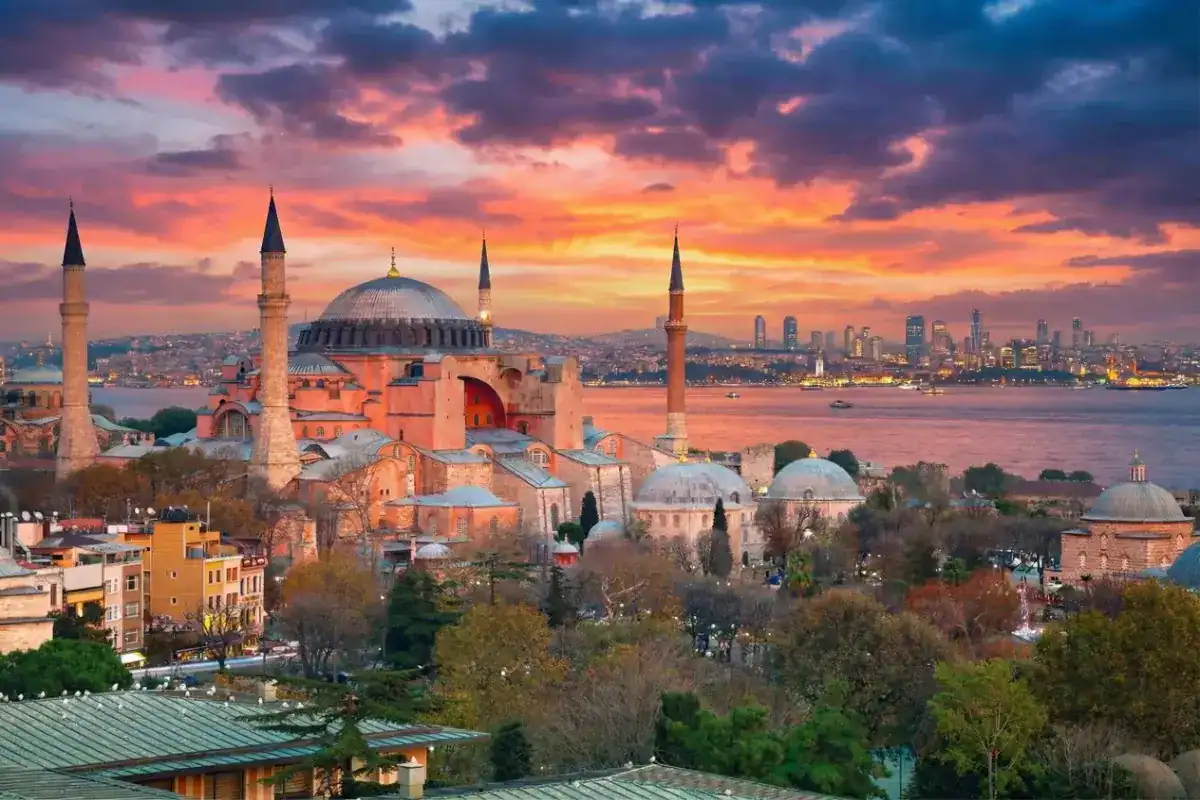
Istanbul’s major sights — Hagia Sophia, the Blue Mosque, Topkapi, the Grand Bazaar, Bosphorus ferries — operate normally and handle very large visitor numbers daily. The advisory asks for heightened awareness in crowded public spaces generally, including transport hubs, markets, malls, places of worship and major events. That applies to a queue at Hagia Sophia as much as anywhere else.In practice the issues visitors meet at the sights are not security ones. Pickpocketing is common in the bazaar, on İstiklal and on packed trams. Ticket touts and unofficial “guides” outside the major monuments overcharge; buy tickets through official channels or your tour. And the venue that seats you without showing prices is the single most reported complaint in the Sultanahmet area.Go early for the big sights, keep valuables where you can feel them, and walk away from any demonstration rather than stopping to watch.
We won’t claim a guided tour makes you safe. It doesn’t change the advisory level, and it doesn’t replace following official advice.What it does change is concrete. You have a local phone number that answers in Turkish. Your transfers, entry tickets and hotels are arranged by people who know which operators are reliable. You are less exposed to the problems that target visitors navigating alone: the unmetered taxi, the unpriced menu, the ticket tout. If a site closes, a road shuts or a domestic flight moves, someone else re-plans your day. And you are dealing with a TÜRSAB-licensed agency with written terms rather than a stranger with a van.None of that is a security service. If you want the practical version of the difference, ask us for the written inclusions and the support contact for your dates, and judge it on that.
Ready when you are
Current Istanbul tour options
Booked and coordinated by One Nation Travel, with guided and transport services provided by experienced local professionals and selected providers. Availability, assignments and cancellation terms are confirmed for each booking.
Still unsure about Istanbul? Talk to a specialist.
Tell us your dates and our team will review the current official guidance and available local services for Istanbul — no pressure, no obligation. We reply as soon as possible.
✓ TÜRSAB licensed (No. 6073)
✓ Experienced local providers
✓ Agency established in 2008
✓ Written price and inclusions