
The underground city most often associated with a population of up to 20,000 people is Derinkuyu Underground City, one of the deepest and most elaborate subterranean settlements in Cappadocia. Carved into soft volcanic rock, it descends through multiple levels of living areas, food stores, churches, wells, ventilation shafts, and defensive passages. A visit is not simply a look at a cave; it is a lesson in how entire communities adapted to insecurity, climate, and the unusual geology of central Türkiye.
For most visitors, Derinkuyu takes 45 to 90 minutes to explore. The passages can be narrow, low, dimly lit, and occasionally crowded, so it is best suited to travelers who are comfortable with enclosed spaces and uneven steps. The payoff is seeing how carefully this underground world was designed to support long stays below ground.
📋 Quick Facts
| Best Time to Visit | April to June and September to October, when Cappadocia’s daytime temperatures are more comfortable for touring |
| Time Needed | About 45–90 minutes inside the underground city, plus driving time from your hotel |
| Difficulty | Moderate; expect narrow corridors, stairs, low ceilings, and limited room to pass in some sections |
| Must-Bring | Comfortable walking shoes, a light layer, water, and patience for tight passageways |
| When to Go | What It Feels Like | Best For |
|---|---|---|
| Morning | Usually calmer, with more room in narrow tunnels | Travelers who dislike crowds or want more time to study the details |
| Midday | Often busier, especially during spring and fall group-tour season | Visitors combining Derinkuyu with a full-day south Cappadocia route |
| Late afternoon | Can be quieter, though timing depends on local tour schedules and seasonal daylight | Independent travelers staying nearby or returning from Ihlara Valley |
Why Derinkuyu Was Built Below Ground
Cappadocia’s volcanic landscape made underground construction possible. Over long periods, eruptions covered the region with ash that hardened into tuff, a rock soft enough to carve with hand tools but stable enough to form rooms, corridors, and shafts when maintained carefully. People first used the rock for simple storage spaces, animal shelters, and homes. Over time, those spaces expanded into far more complex underground settlements.
Derinkuyu was not built as a single project by one ruler or one generation. It developed over centuries, with later residents expanding and adapting earlier chambers. Archaeologists and historians continue to debate exactly how early its deepest origins go, but the city was certainly used and enlarged in the Byzantine era, when Christian communities needed places of refuge during periods of conflict and raids.
The famous estimate of 20,000 people is best understood as a potential capacity rather than proof that that number lived underground permanently every day. The city could shelter a very large population, along with animals and supplies, for limited periods. It was designed for survival during danger, not as an ordinary town where residents spent every season of their lives below the surface.
A City Planned for Defense, Food, and Survival
What makes Derinkuyu remarkable is not only its depth. It is the practical planning visible throughout the site. Visitors move through areas that once had different functions: stables near the entrance, storage rooms, kitchens, communal spaces, religious rooms, and living quarters farther inside. The layout helped people protect valuable supplies while keeping vulnerable areas deeper underground.
One of the strongest defensive features was the use of enormous circular stone doors. These could be rolled across key passageways from the inside, blocking access to invading forces. The doors were difficult to move from the opposite side and had small openings that allowed defenders to observe or act through the barrier without opening it.
Ventilation was equally important. Deep shafts moved fresh air through the city’s levels, allowing people to remain below ground far longer than a short emergency hiding period. Some shafts also connected to wells. Certain water sources were deliberately arranged so that people underground could access water without relying entirely on surface supplies, reducing vulnerability during an attack.
Derinkuyu’s passages also reflect a social reality: moving through the site was controlled. Narrow corridors slowed large groups, forced people to move single file, and made it easier to defend choke points. A modern visitor may find these tunnels uncomfortable. For the people who created them, that tightness was part of the protection.
Pro Tip
Visit the underground city before lunch if possible. The interior stays cool even in summer, but narrow stairways and corridors feel much easier when groups are spread out. If you are prone to claustrophobia, tell your guide before entering and stay close to the exit route rather than pushing into every lower section.
What You Will Actually See Inside
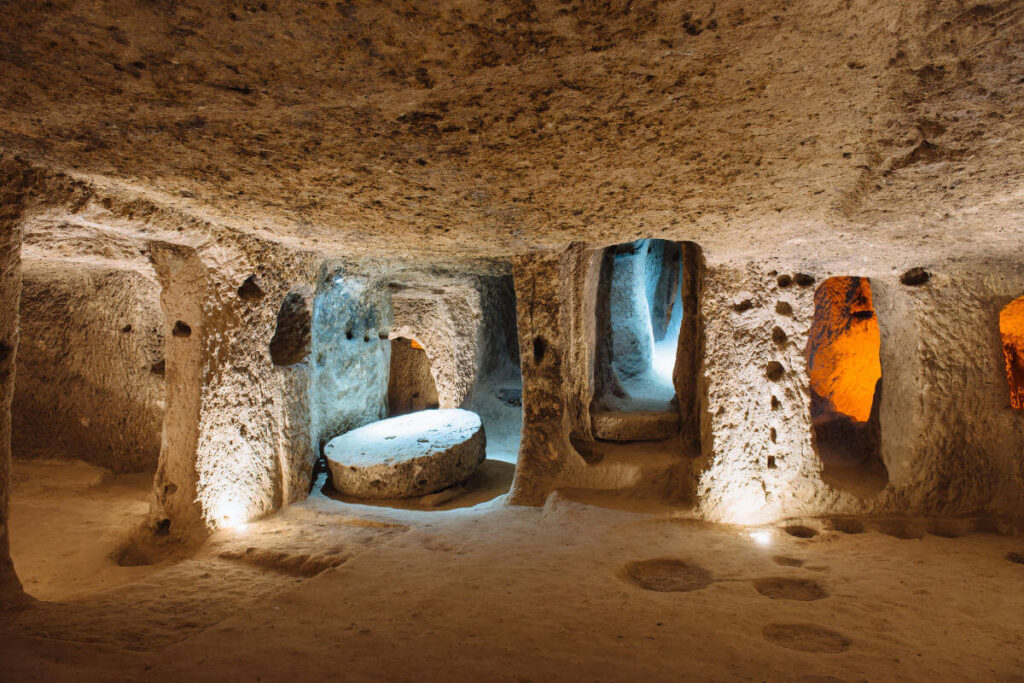
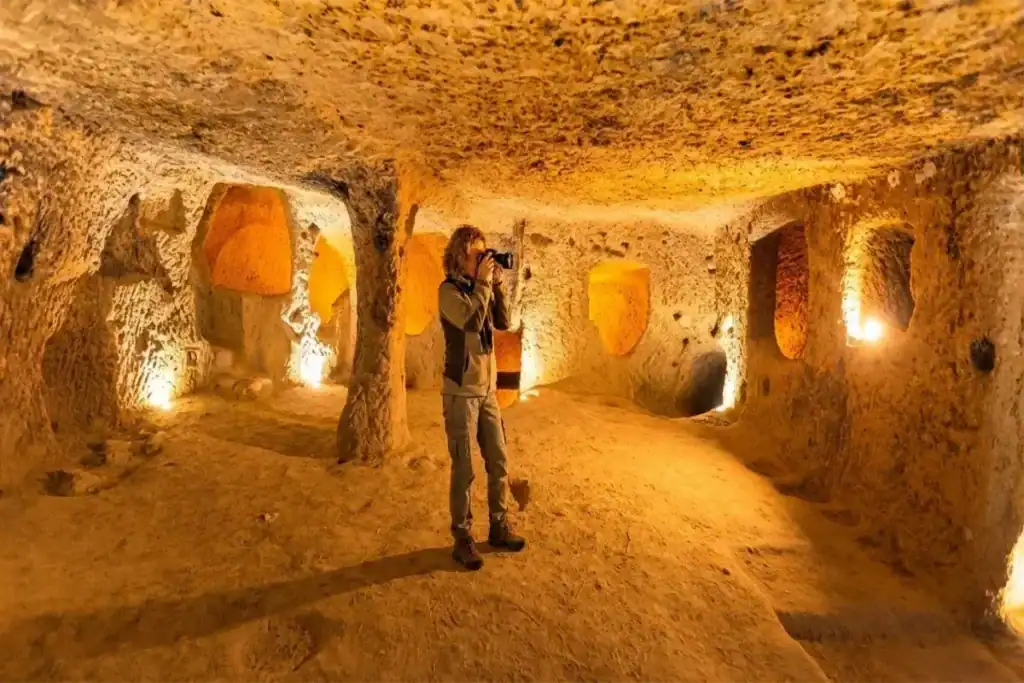
The entrance gives little warning of the scale below. Once inside, the route winds through sloping paths and staircases with rooms opening off the main passage. Lighting allows visitors to see the carved architecture, but the experience remains deliberately close to the original conditions: rock underfoot, low ceilings, compressed spaces, and cool air.
Many visitors are surprised by the range of spaces. Rather than seeing one continuous tunnel, you encounter a functioning settlement organized around daily needs. There are areas interpreted as kitchens and food stores, places for livestock, presses and storage facilities, gathering rooms, and religious spaces. The presence of stables near upper levels was practical: animals could be brought in quickly while keeping the smell and mess away from deeper residential areas.
Some sections are no longer accessible to the public, either for preservation or safety reasons. That does not reduce the value of the visit. The open route already gives a clear sense of how far this underground settlement extended and how much labor went into its construction. It also helps to remember that the city connected to a wider regional pattern. Cappadocia has several underground settlements, including Kaymakli Underground City, which is another important option for travelers interested in subterranean life.
Derinkuyu tends to make the strongest impression on travelers who prefer history with a physical sense of place. Reading about defensive tunnels is one thing; bending through a narrow corridor and standing beside a stone door built to seal a community inside makes the history much more immediate.
Derinkuyu or Kaymakli: Which Underground City Should You Visit?
If your schedule allows only one underground city, Derinkuyu is often the better choice for travelers who want to understand the scale and depth of Cappadocia’s subterranean settlements. It is known for its deeper accessible levels and for the strong sense that a complete community could function below ground.
Kaymakli, meanwhile, is a useful alternative for visitors who want a slightly more compact route or are staying closer to Nevşehir. Its layout feels different, with a wider horizontal spread in some areas. Neither site is “better” in every circumstance; your choice should depend on where you are staying, the day’s route, your comfort in confined spaces, and how much underground exploration you want.
A well-planned south Cappadocia day often pairs an underground city with the Ihlara Valley, where a river-cut gorge, greenery, and rock-carved churches provide a complete contrast to the enclosed world below ground. This combination works especially well after a morning spent in narrow corridors, because the valley offers open air and a gentler walking environment.
How to Fit Derinkuyu Into a Cappadocia Itinerary
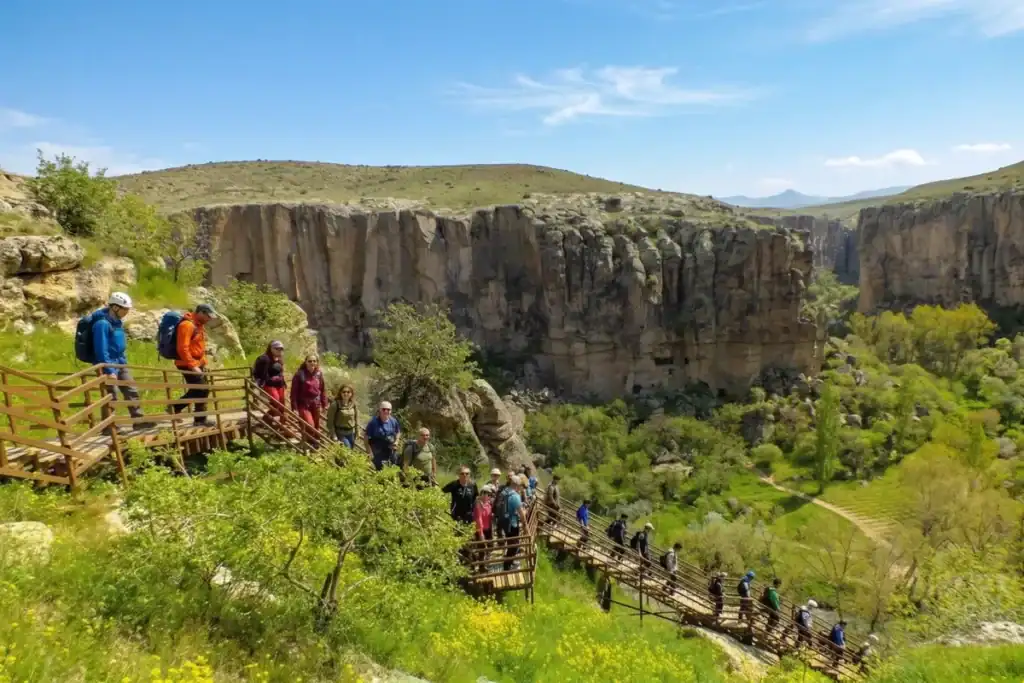
Derinkuyu is south of the main hotel areas around Göreme, Uçhisar, and Ürgüp. It is not usually a quick stop between breakfast and a balloon ride. Plan it as part of a southern route, allowing time for the drive as well as the visit itself.
For a two-night stay, the most sensible rhythm is to place Derinkuyu on your second full day. Use the first morning for a balloon flight if you choose one, then visit the Göreme Open-Air Museum, valley viewpoints, and the rock formations around the central part of the region. Reserve the underground city for the following day, alongside Ihlara Valley, Selime Monastery, or other south Cappadocia stops.
This sequencing matters because a balloon morning begins extremely early and weather can affect flight operations. Trying to schedule a balloon flight, hotel check-out, a long drive south, and an underground city visit all on the same morning can make the day feel rushed. For more help choosing the right pace, see our practical first-time Cappadocia trip plan, including timing and route considerations.
Local Flavor Alert
After an underground-city visit, stop for a regional lunch rather than rushing back toward Göreme. Cappadocia is known for dishes such as testi kebab, slow-cooked in a sealed clay pot, as well as soups, gözleme, and local dried fruit. Confirm preparation time if ordering testi kebab, since some restaurants prepare it to order.
Practical Advice for First-Time Visitors
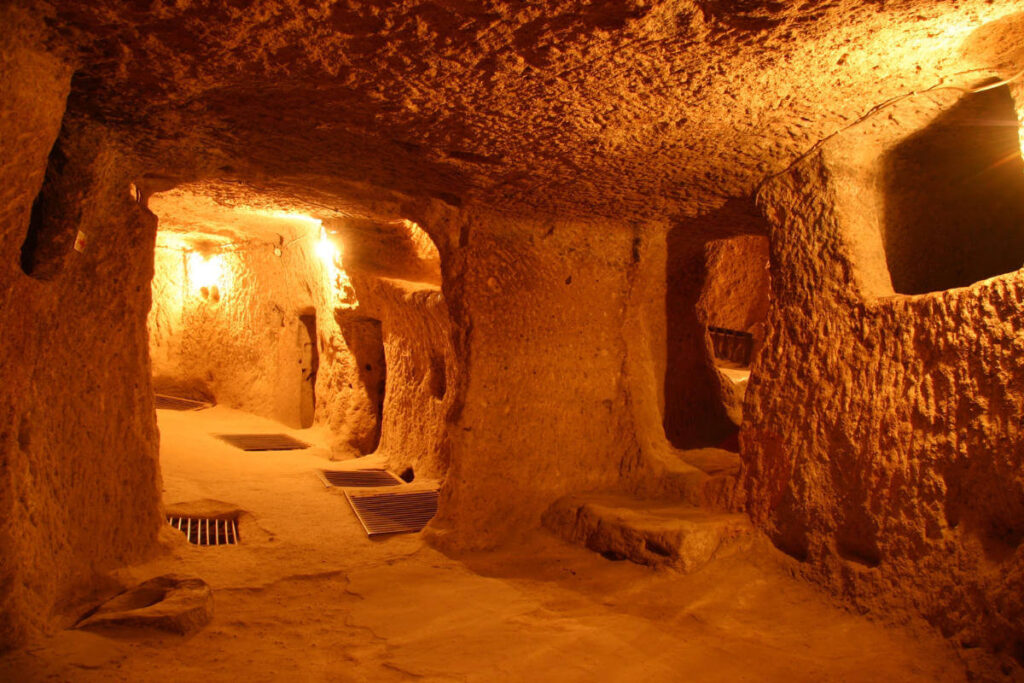
Derinkuyu is manageable for many travelers, but it is not a casual walk-through attraction. The stairways can be steep, the rock floor can be uneven, and some passages require visitors to bend. Wear shoes with grip rather than sandals or smooth-soled footwear. A light jacket is useful because the underground temperature remains noticeably cooler than the summer heat outside.
People with significant claustrophobia, mobility limitations, respiratory concerns, or difficulty on stairs should think carefully before entering. There is no need to force the experience. The central Cappadocia landscape offers plenty of above-ground alternatives, including valleys, rock-cut churches, viewpoints, pottery workshops, and open-air historical sites.
Photography can be challenging because the interiors are dim and the corridors are narrow. Avoid stopping in a passageway where other visitors need to pass. A phone with night mode is usually more practical than trying to manage large camera equipment. Flash photography may be distracting for others and can be restricted in sensitive areas, so follow posted rules and guide instructions.
It is also worth confirming the day’s access conditions before departure. Opening hours, restoration work, and route availability can change. Travelers visiting independently should check the latest local information through their hotel or a reliable local provider, especially in winter or during public holidays.
Why the Underground City Changes How You See Cappadocia
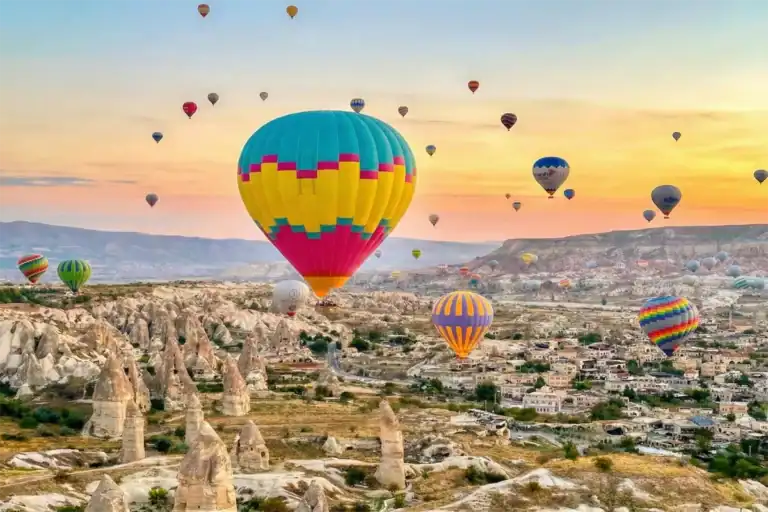
Cappadocia is often pictured through its fairy chimneys, valleys, cave hotels, and balloon-filled skies. Those scenes are central to the region’s appeal, but Derinkuyu adds a different perspective. It shows that people did not merely live among Cappadocia’s unusual rock formations; they reshaped them into places of security, worship, food storage, and communal survival.
The underground city is most meaningful when you give it enough time and put it in context. Visit after seeing the exposed valleys and villages above ground, then notice the contrast: wide volcanic horizons outside, intricate defensive architecture below. That combination explains why Cappadocia rewards more than a quick overnight stop.
Recommended Cappadocia Tour Options
Travelers with limited time may prefer a two-day Cappadocia itinerary with domestic flights and a cave-hotel stay, which reduces the effort of arranging transfers while leaving time for the region’s major sights. A balloon-inclusive option is a better fit for travelers who want the sunrise flight built into a short visit. If you have an extra day and want to connect Cappadocia with central Anatolian history, a three-day route that includes Konya provides a slower, more varied journey.
Frequently Asked Questions About Derinkuyu Underground City
Did 20,000 people really live in Derinkuyu?
Derinkuyu is commonly described as having the capacity to shelter up to 20,000 people, along with livestock and supplies. This figure should be viewed as an estimate of refuge capacity rather than a claim that 20,000 people permanently lived underground at the same time.
How deep is Derinkuyu Underground City?
The site extends many levels below ground, with the deepest areas reaching roughly 60 meters (about 200 feet) below the surface. Not every level is open to visitors, but the public route still reveals its extraordinary depth and complexity.
Is Derinkuyu safe to visit?
Yes, the visitor route is managed for tourism, but the site includes narrow tunnels, low ceilings, stairs, and uneven surfaces. Follow your guide, stay aware of other visitors in tight passages, and skip it if confined spaces cause serious discomfort.
Can you visit Derinkuyu and Ihlara Valley in one day?
Yes. They are commonly paired on a south Cappadocia day because they are in the same general direction from Göreme. Start early, allow time for the drive, and avoid overloading the day with too many additional stops.
Is one night in Cappadocia enough to see the underground city?
It is possible, but two nights are more comfortable. A single-night schedule can feel rushed if you also want a balloon flight, the Göreme Open-Air Museum, valley stops, and an underground-city visit. Our guide to 48 hours in Cappadocia from Istanbul explains how to organize a short stay without wasting valuable touring time.
If you would like help combining Derinkuyu with the right hotel area, flights, balloon timing, and sightseeing pace, plan your Cappadocia trip with One Nation Travel.
Choose your next step
Recommended Cappadocia tours
These bookable options are the strongest verified matches for this guide. Compare the pace, focus, and current starting price before you choose.
2-Day Cappadocia Tour from Istanbul: Flights, Cave Hotel & Meals
A practical route for travelers who want to include Turkey Tours with the main logistics planned.
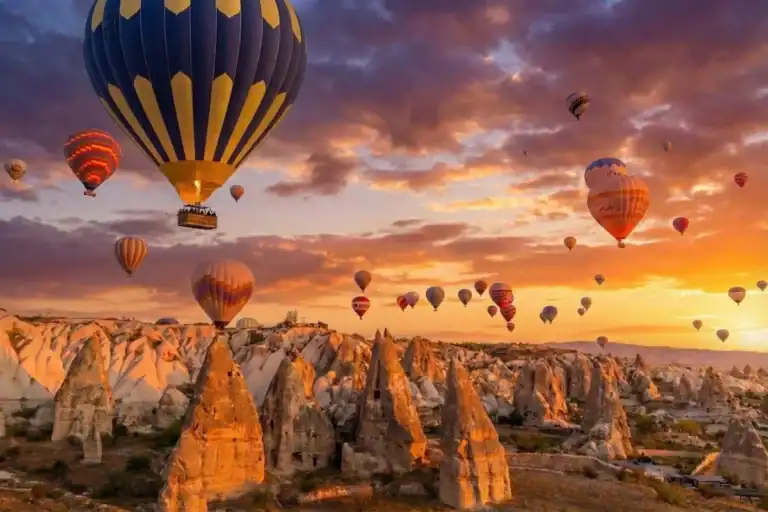
2-Day Cappadocia Tour from Istanbul by Plane with Hot Air Balloon
A practical route for travelers who want to include Turkey Tours with the main logistics planned.
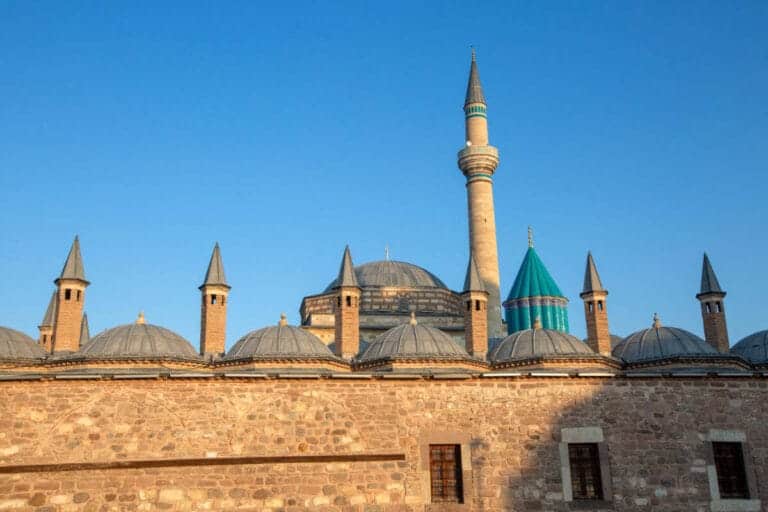
3-Day Cappadocia & Konya Tour from Istanbul
A practical route for travelers who want to include Turkey Tours with the main logistics planned.
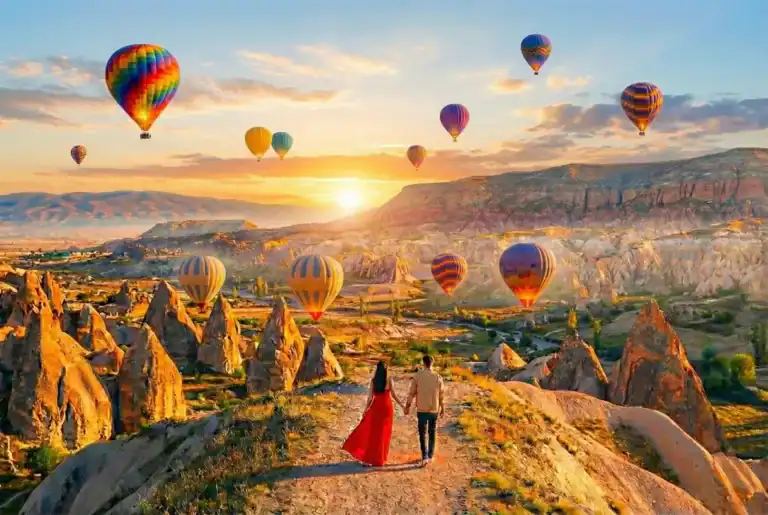
2-Day Cappadocia Adventure with Sunrise Hot Air Balloon Ride
A practical route for travelers who want to include Turkey Tours with the main logistics planned.