
The practical answer: Three days is the right amount of time to experience Ephesus and Pamukkale without turning the trip into a long-distance dash. Use one full day for Ephesus and nearby Selçuk, one for Pamukkale and Hierapolis, and a final day for a slower archaeological stop or your onward transfer. The key choice is whether to base yourself in Selçuk/Kuşadası first and finish in Pamukkale, or join a coordinated multi-day route.
This itinerary suits travelers who want Roman ruins, early Christian landmarks, and thermal landscapes in one compact western Turkey trip. It also works well as part of a longer route linking Istanbul, Izmir, Antalya, or Cappadocia. The important planning decision is not simply what to see; it is how to manage the three-hour-plus road journey between the Ephesus area and Pamukkale while still leaving enough energy to enjoy both sites.
What Matters Most
- Plan a full morning and early afternoon for Ephesus; the site is large, exposed, and far more rewarding when you are not rushing toward the exit.
- Stay near Selçuk or Kuşadası before Ephesus, then overnight in Pamukkale or Denizli after visiting the terraces and Hierapolis.
- The transfer between the Ephesus area and Pamukkale is typically around three hours by road, before rest stops, hotel pickups, or detours.
- Spring and fall usually offer the most comfortable walking conditions; summer can be intensely hot at both archaeological sites.
- Budget separately for site admission, optional areas such as the Terrace Houses, meals, thermal bathing, and transportation unless your booked itinerary clearly includes them.
- Wear shoes with grip, carry water and sun protection, and expect uneven ancient paving at Ephesus and wet, slippery surfaces around Pamukkale.
Why Ephesus and Pamukkale Belong on the Same Route
Ephesus and Pamukkale make sense together because they offer two very different sides of Anatolia: a major Roman city with streets, monuments, homes, and public buildings still legible on the ground, followed by a mineral landscape shaped by flowing thermal water. They are not next door to each other, however. Treating them as a single day trip from Izmir or Kuşadası often means spending more time in transit than at the sites.
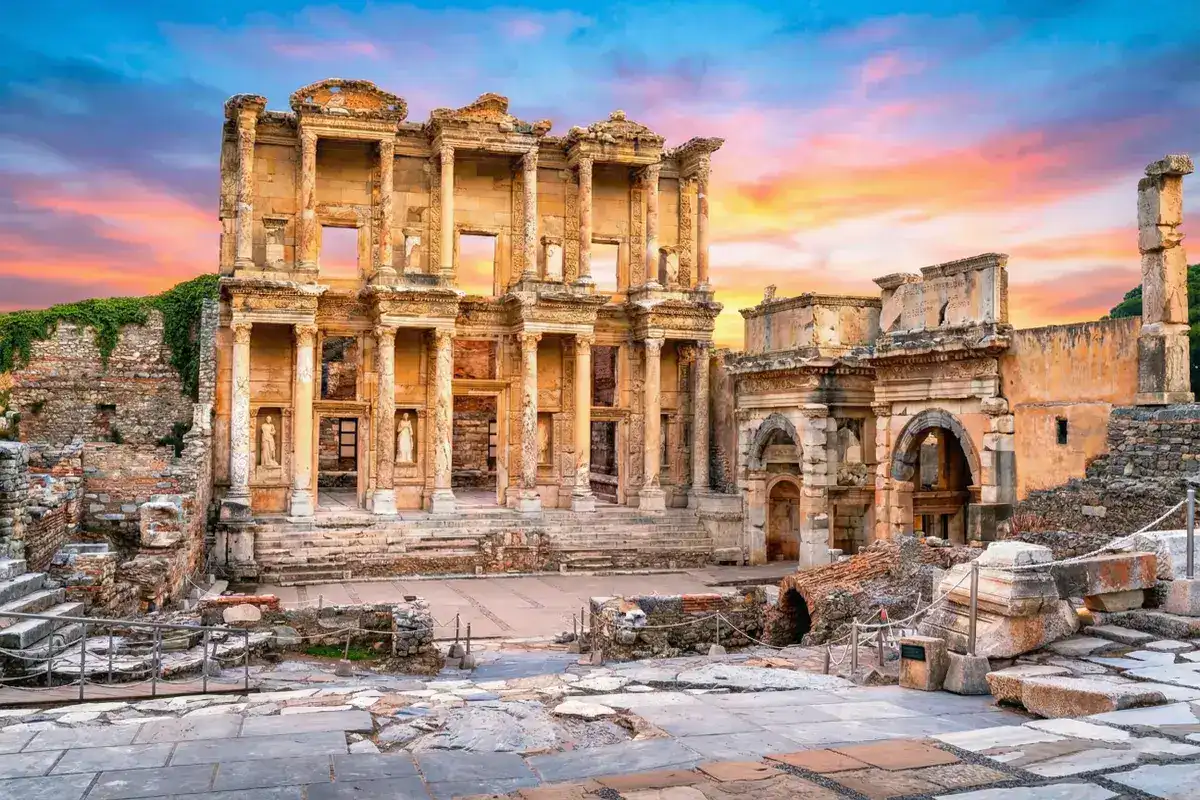
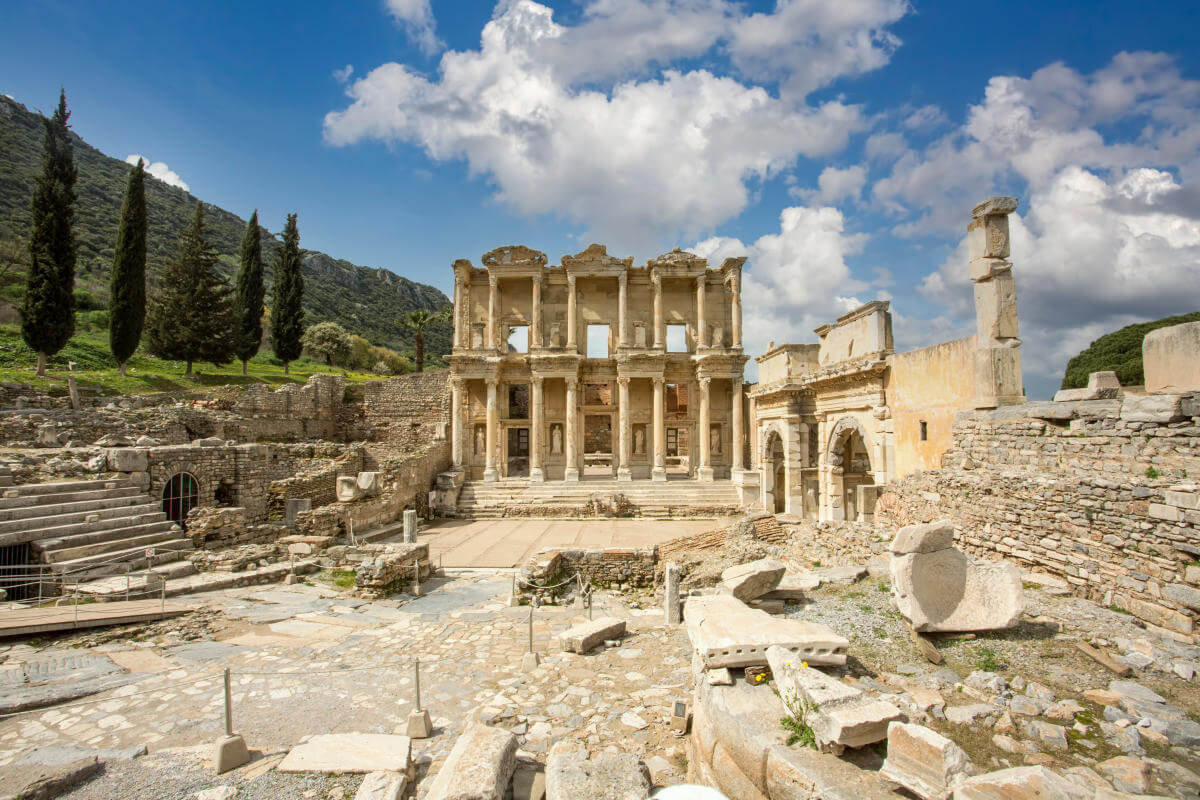
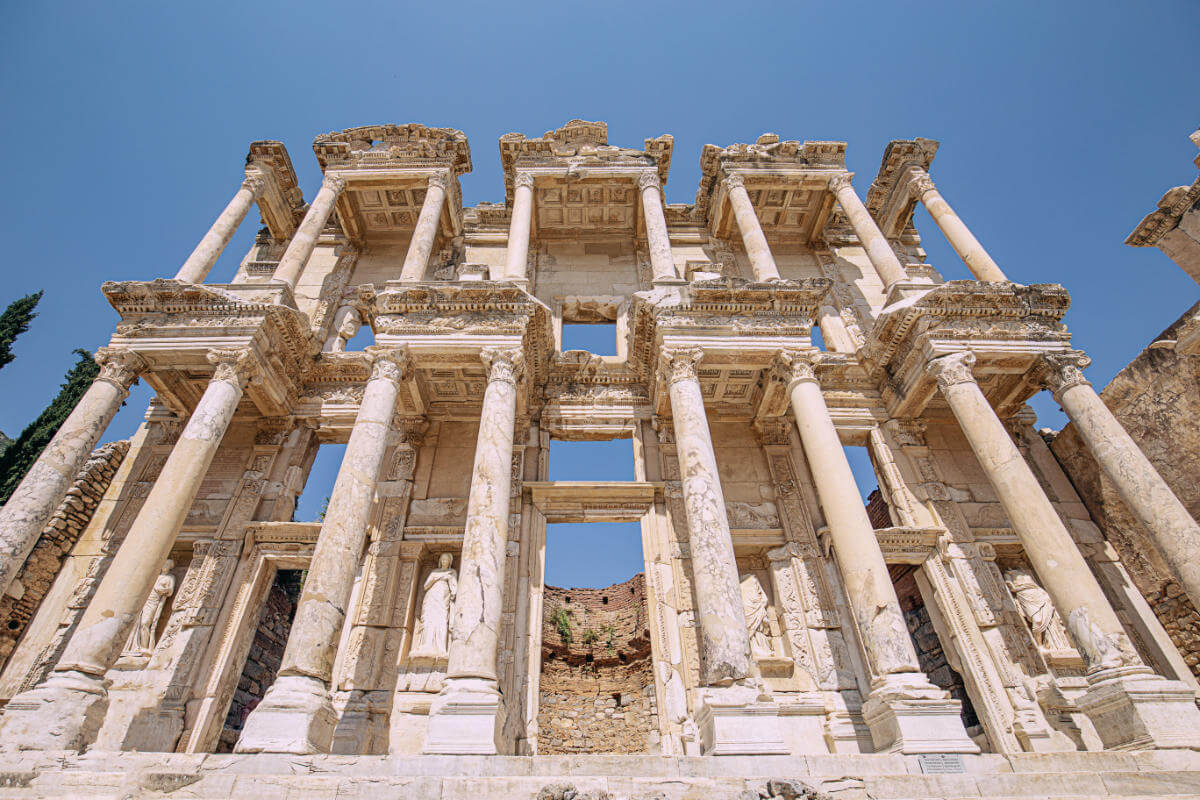
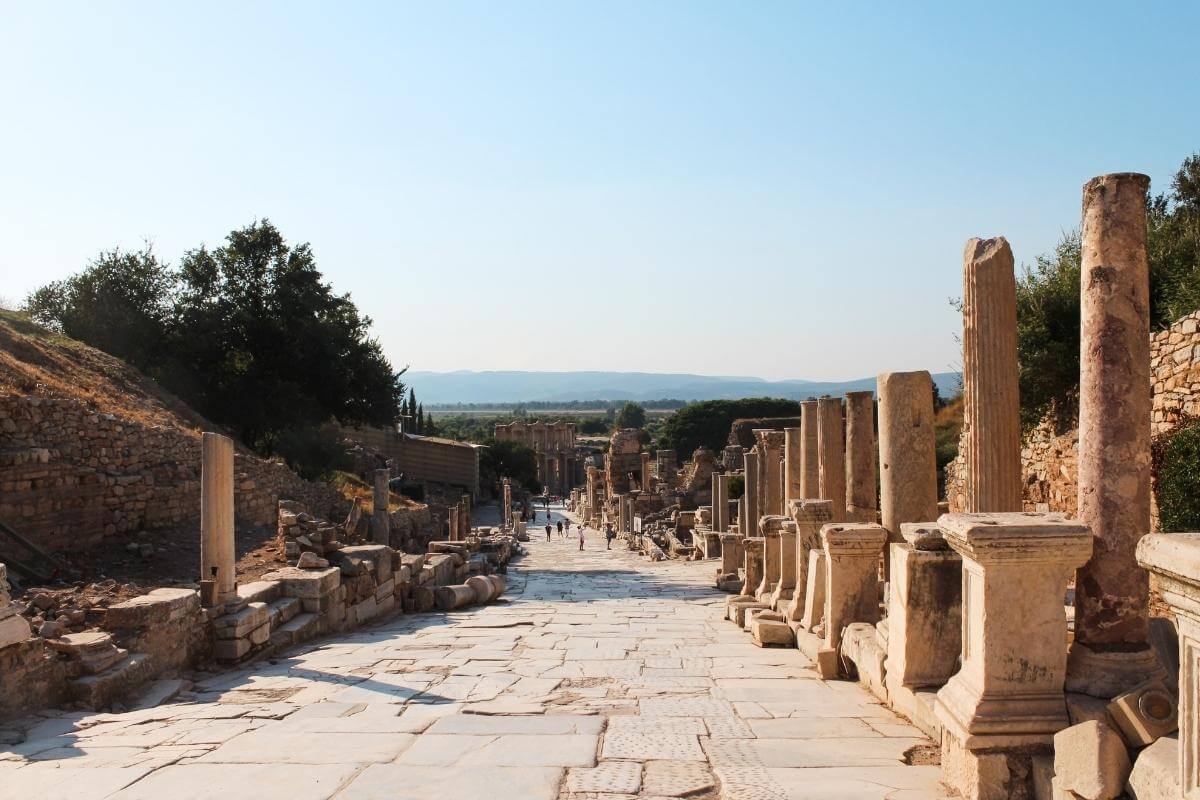
At Ephesus, the appeal is detail. You can stand before the façade of the Library of Celsus, follow Curetes Street downhill, and appreciate the scale of the Great Theatre of Ephesus. At Pamukkale, the experience is more about the landscape: bright white calcium terraces, shallow water in designated areas, and the ruins of Hierapolis-Pamukkale spread across the plateau above.
For historical context before you go, read the history of Ephesus, from Ancient Greece to Roman glory. It makes the sequence of streets, fountains, civic buildings, and later Christian landmarks much easier to understand on site.
Day 1: Explore Ephesus, Selçuk, and the Surrounding Sites
Base yourself in Selçuk if your priority is archaeology and a quieter small-town feel. Choose Kuşadası if you prefer a larger resort town and waterfront dining. Both can work, but Selçuk reduces local travel time for the core sites.
Start early at Ephesus
Arrive as early as practical. Morning light is gentler, tour traffic is lighter than later in the day, and there is very little shade once you are inside. A sensible visit allows time to walk from the upper entrance through the main city rather than seeing only the Library of Celsus photo stop. Short on time? Our ephesus day trip from istanbul covers these highlights in a single well-paced day.
- Ephesus Ancient City Ruins: Follow the main route through public baths, fountains, temples, and commercial streets.
- Ephesus Ancient Greek Theatre: Allow time to climb partway up for its scale and views across the former harbor approach.
- Terrace Houses in Ephesus: Worth prioritizing for travelers interested in daily life, mosaics, frescoes, and the homes of wealthy residents. Check current access and any separate admission requirement before arrival.
Do not underestimate the walking. Ancient marble paving can be uneven and slick, especially where it has been polished by generations of visitors. Closed-toe shoes or supportive sandals are usually a better choice than smooth-soled footwear.
Add one or two nearby landmarks, not everything
After Ephesus, choose according to your interests and energy. The House of the Virgin Mary is a short drive into the hills and is meaningful for pilgrims and travelers interested in Christian heritage. In Selçuk itself, the Basilica of Saint John and Isa Bey Mosque make an easy cultural pairing.
If you have only one day in the area, resist the urge to add every site. Ephesus plus the Terrace Houses and one nearby landmark is a satisfying day. For a more detailed site-by-site plan, see this Ephesus travel guide to seven ruins worth seeing.
Day 2: Travel to Pamukkale and Visit the Travertines and Hierapolis
Leave the Ephesus area early. The road transfer to Pamukkale is substantial, so the goal should be to arrive with enough daylight for both the terraces and the ancient city above them. A private transfer offers flexibility; a scheduled group itinerary removes the need to coordinate pickup timing, baggage, stops, and the onward hotel.
Walk the Pamukkale terraces responsibly
The Travertines of Pamukkale are fragile formations created by mineral-rich water. Access rules and water flow can vary, and visitors are generally directed through specific walking areas. Bring a small bag for shoes, move slowly on wet surfaces, and do not assume every terrace will be full of water.
The best visual conditions often come later in the afternoon, when the white slopes soften in lower-angle light. That said, leave enough time to reach Hierapolis; it is more than an add-on to the terraces.
Give Hierapolis the attention it deserves
Hierapolis was an ancient spa city, and its scale becomes clear once you move beyond the terrace viewpoint. Prioritize the theater, broad necropolis, and the remains around the central ancient city. The Necropolis of Hierapolis is especially rewarding for travelers who enjoy archaeology and have the time to walk farther from the busiest paths.
You may also wish to visit Cleopatra’s Pool at Pamukkale, also known as the Antique Pool. Swimming, operating hours, capacity, and admission are separate practical matters to verify locally or with your tour provider before relying on it as a fixed part of the day.
Practical tip: Bring a swimsuit only if you are genuinely interested in thermal bathing. Otherwise, keep the day simple: water, a hat, sunscreen, a light layer for the evening, and footwear you can easily remove for the terrace route.
Day 3: Choose a Slow Finish or an Efficient Departure
Your final day should reflect where you are headed next. Travelers continuing toward Antalya, Cappadocia, or Istanbul should prioritize a reliable departure rather than adding an ambitious detour. Those with a late flight or private transport can use the morning for one additional archaeological stop.
Option 1: Visit Laodicea for a quieter archaeological morning
Laodicea is a sensible choice for travelers who want another major ancient site without returning to the crowds of Ephesus. Its stadium, churches, colonnaded streets, and excavated structures offer a different sense of scale. Confirm transport and opening arrangements in advance, especially if you are relying on taxis or public transportation.
Option 2: Return toward Izmir with a Selçuk stop
If you are looping back toward Izmir, use the route to visit the remains associated with the Temple of Artemis in Selçuk. It is historically important as one of the Seven Wonders of the Ancient World, but manage expectations: the visible remains are limited compared with Ephesus. It works best as a brief stop, not the centerpiece of a day.
Option 3: Connect onward without overplanning
For an onward domestic flight, bus, or transfer, build in time for hotel checkout, road traffic, and luggage handling. Denizli is the practical transport hub for Pamukkale, while Izmir is the main hub for Ephesus and Selçuk. Do not schedule an inflexible flight immediately after a full morning at a ruin site unless your transportation is confirmed and you are comfortable cutting the visit short.
What Will This Three-Day Route Cost?
Your total cost depends less on the ruins themselves than on transport style, accommodation level, and whether you book services separately or as a coordinated package. The most common expenses are lodging for two nights, transportation between the Ephesus region and Pamukkale, site admission, meals, guide services, and optional thermal bathing.
| Travel style | Best for | What to watch carefully |
|---|---|---|
| Independent travel | Travelers comfortable arranging hotels, tickets, buses, and local transfers | Transfer timing, station-to-hotel transport, separate guide and entrance costs |
| Private arrangement | Families, small groups, and travelers who value flexible pacing | Exactly which transfers, admissions, meals, guide hours, and hotel nights are included |
| Multi-day escorted itinerary | Travelers starting in Istanbul or Izmir who prefer coordinated logistics | Flight timing, accommodation category, optional activities, and pickup locations |
For context, the 3-Day Pamukkale and Ephesus Tour from Istanbul with Flights starts from USD 648, while the 3-Day Pamukkale & Ephesus Tour from Izmir starts from USD 426. These are starting prices and can change. Review the live tour page for the current itinerary, inclusions, accommodation details, and available departure dates before booking.
Should You Travel Independently or Book a Three-Day Tour?
Independent travel is a good fit if you have a flexible schedule, enjoy arranging local transportation, and are willing to treat the Ephesus-to-Pamukkale transfer as a full travel segment rather than a sightseeing day. It can also make sense if you already have accommodation and transport booked in Izmir or Denizli.
A coordinated tour is generally the better choice when you are starting in Istanbul, have limited time, or do not want to manage domestic flights, airport transfers, intercity transport, hotel coordination, and site sequencing separately. From Istanbul, the logistics are the main value: Ephesus and Pamukkale are achievable in three days, but only with an orderly route.
Before booking any option, verify the departure city, flight or road-transfer timing, hotel location, room basis, admission fees, meals, guide language, and whether the Terrace Houses or Cleopatra’s Pool are included or optional. Travelers who want Ephesus alone in one long day may prefer a private Ephesus day trip with flights from Istanbul, but it does not replace the time needed for Pamukkale.
For a cancellation or date change, notice must be given at least 5 days before the tour starts; non-refundable flight and bus ticket costs are deducted from the paid balance; with less than 5 days notice, or for a no-show, the full payment is non-refundable.
Choose your next step
Recommended Ephesus tours
These verified options are the closest available matches for this article’s destination, route intent, and trip length.

3-Day Pamukkale and Ephesus Tour from Istanbul with Flights
A 3 days Cultural & Heritage Tour route covering Pamukkale, Ephesus and 1 more destination.
View tour details →3-Day Pamukkale & Ephesus Tour from Izmir
A 3 days Cultural & Heritage Tour route covering Pamukkale, Ephesus and 1 more destination.
View tour details →
3-Day Ephesus & Cappadocia Tour from Izmir with Flights
A 3 days Cultural & Heritage Tour route covering Ephesus, Cappadocia and 1 more destination.
View tour details →
Private Ephesus Day Trip with Flights from Istanbul
A 17 hours Cultural & Heritage Tour route covering Ephesus, Istanbul.
View tour details →Questions Travelers Often Ask
Can Ephesus and Pamukkale be done in two days?
Yes, but it will be fast. Two days can work with efficient transfers or flights, yet three days gives you time to see Ephesus properly, travel without pressure, and explore Hierapolis beyond the terrace viewpoint.
What is the best season for this itinerary?
Spring and fall are usually the most comfortable for outdoor walking. Summer offers long daylight but strong heat and sun exposure. Winter can be quieter, though weather and water conditions at Pamukkale may be less predictable.
Is Ephesus suitable for travelers with limited mobility?
Some areas are accessible, but the site includes slopes, uneven stone paving, and long walking distances. Discuss mobility needs before booking so transport, route pacing, and assistance can be considered realistically.
Should I stay in Selçuk, Kuşadası, Pamukkale, or Denizli?
Choose Selçuk for proximity to Ephesus and local heritage sites; Kuşadası for a larger coastal base; Pamukkale for easy access to the terraces; and Denizli for broader transport connections. For this route, splitting nights between the Ephesus area and Pamukkale is usually the least rushed plan.
Make the Route Work for Your Schedule
A three-day Ephesus and Pamukkale itinerary works because it gives each destination its own day and treats the road between them realistically. Start with Ephesus when your energy is highest, allow the transfer day to lead naturally into Pamukkale, then use the final day for Laodicea, Selçuk, or a well-timed onward connection.
If you would like help matching this route to your arrival city, preferred hotel style, and next destination, plan your Turkey trip with One Nation Travel. For broader route ideas, compare this itinerary with the best seven-day Turkey itinerary or the practical advice in the Pamukkale day trip guide.